 My Account



Built Not Bought
A (short) History of Hand-Built Bikes and Custom Culture in the UK
There is a motorcycle out there that was never drawn by a committee, never designed by a focus group, and has never once appeared in a dealer’s forecourt. It exists because someone, probably in a draughty garage somewhere in the UK, had a vision, a welder, and the stubbornness to see it through. That bike is a custom build. And this is its story.
WHERE IT ALL BEGAN: THE SHED AND THE SURPLUS
The origins of the ‘bobber’ stretch back further than most people realise, not to the post-war years, but to the late 1920s, when riders first began stripping unnecessary weight from their machines to improve speed and handling. But it was the aftermath of the Second World War that truly lit the fire.
Both American GIs and British veterans returned home to find military stockyards full of war-worn machines. They bought them up, stripped off the military hardware, and repurposed them as civilian rides. The instinct was the same on both sides of the Atlantic: take what you have, remove what you don’t need, and make it yours.
In Britain, this tradition of tinkering in the shed was so deeply ingrained that it largely went unrecorded, seen as just something blokes did, rather than a movement worthy of a name. Which is very British, really. No fuss. No manifesto. Just sparks and ingenuity.
After the war, motorcycles became increasingly affordable as working class transport, and subcultures began to emerge, the Ton-Up Boys, the Rockers, the Café Racers. Thrill-seekers and rebels, the Ton-Up Boys were named after the 100mph speeds their self-modified machines were capable of hitting. These weren’t factory builds. They were ambitions made metal.
THE CHOPPER ERA AND THE AMERICAN INFLUENCE
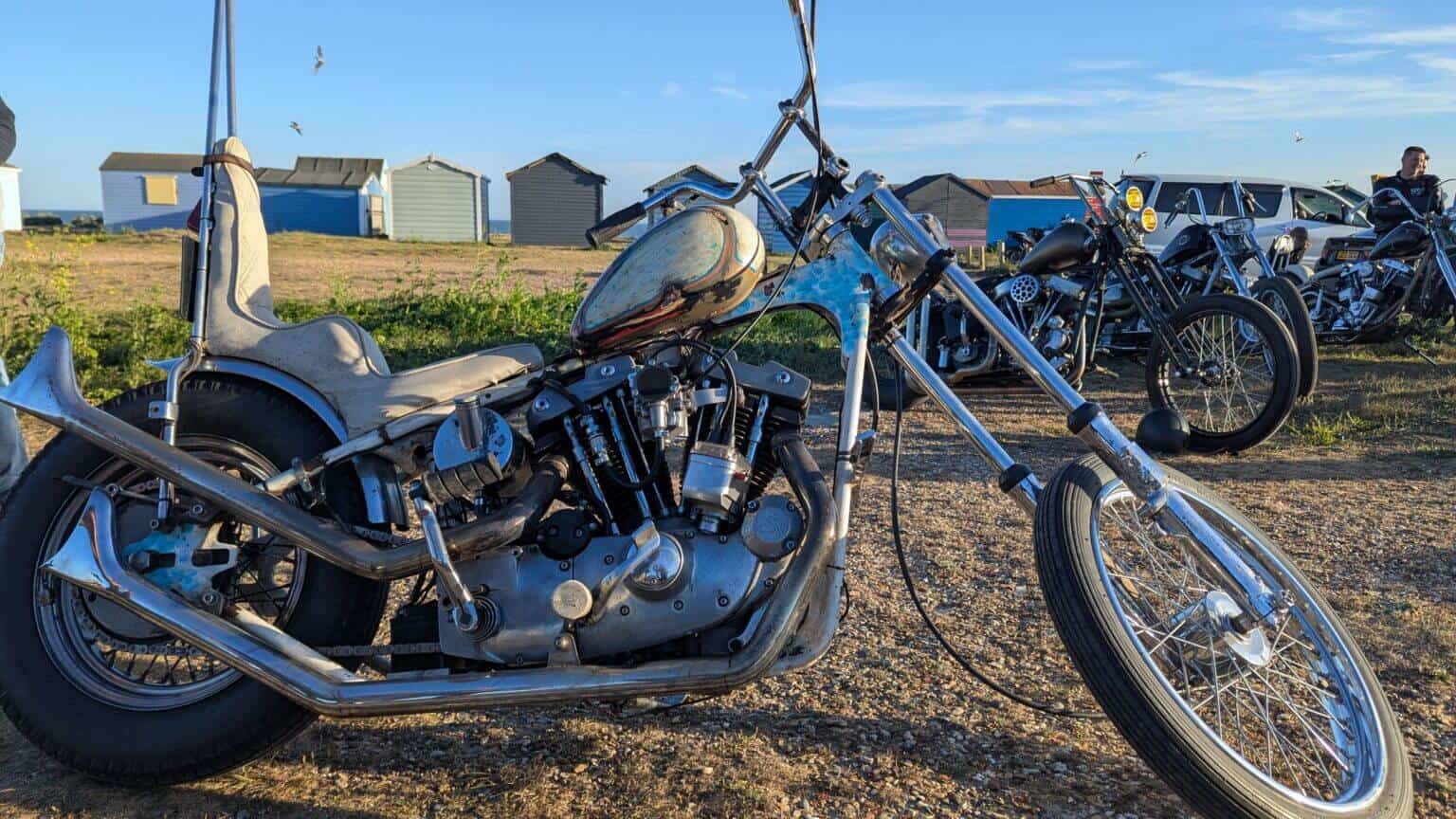
By the late 1960s, the chopper had arrived in Britain — and with it came the full cultural weight of American biker mythology. The public image of choppers was solidified by Easy Rider in 1969, which demonstrated just how far the customiser’s art had come since the early cut-down days.
By the early 1970s, the market for choppers had spread so far and so fast that it touched virtually every corner of the motorcycle world; not just Harleys, but Triumphs, BSAs, Nortons, even Hondas. British builders took the American template and bent it to their own sensibility: leaner, rawer, with less chrome showmanship and more mechanical honesty.
The arrival of Harley-Davidson into British motorcycle culture marked a genuine turning point, those large, powerful V-twins brought with them a spirit of individualism that stirred fresh energy within the scene. But the British custom builder didn’t simply copy the American look. They created a hybrid, Harley soul, British grit.
The British chopper developed its own distinctive identity: a stretched frame providing a low riding position, old-world parts sourced from scrapyards, and an instinct for building something with a story behind it, rather than just a look.
THE BOBBER REVIVAL: BACK TO BASICS
The bobber took something of a back seat through the 1970s to the 1990s as the chopper era prioritised style over function. But it never disappeared, and when it came back, it came back with purpose.
The 2000s and 2010s saw a new generation of British builders rediscover the bobber’s stripped-back philosophy. New boutique garages emerged, reinventing fashionable vintage styles with restraint and an eye for detail — and while the products of these custom shops were still a significant investment, they were far more achievable by ordinary riders doing their own builds.
The factory world noticed. In 2017, Triumph launched their own Bobber, a solo-seat, hardtail-appearance machine built around their 1200cc parallel twin, a direct acknowledgement of the genre’s enduring power and the demand it was generating. When manufacturers start building factory customs, you know the culture has won.
THE CUSTOM BIBLE: BOBBER VS CHOPPER — WHAT’S THE DIFFERENCE?
Worth knowing before you start sketching ideas on the back of a receipt.
- A bobber is defined by ruthless simplicity — no luggage, minimal lighting, bobbed or removed fenders, a solo seat, and the removal of everything that isn’t essential. The silhouette is low, lean, and timeless.
- A chopper takes that philosophy and then asks: what if we made it more dramatic? Extended forks, raked headstocks, longer wheelbase. More statement, less subtlety.
In Britain, the distinction between the two has always been slightly blurred, British choppers have typically shared more DNA with the bobber than their American counterparts, favouring a stripped and purposeful look over pure spectacle. That restraint is part of what makes British customs so compelling.
THINKING ABOUT YOUR FIRST CUSTOM BUILD: WHERE TO START
This is where the dream gets practical — and the good news is that it’s more accessible than you might think.
Start with a donor bike. Triumph is the most popular base for a British bobber or chopper build, parts are plentiful, relatively affordable, and the resale value of a finished build can be significant. BSA and Norton bikes also make excellent projects, though parts are harder to source. For a Harley-style cruiser feel on a British budget, a Triumph Bonneville or a used Harley Sportster are both solid starting points.
Understand the two routes. A bobber conversion works with an existing frame — removing bodywork, fitting a solo seat, bobbing the rear mudguard, and perhaps adding a bolt-on hardtail section for that rigid look. A frame-up custom build starts from bare steel. Both are valid. Both are deeply satisfying. The conversion is the more accessible (and often cheaper) entry point.
Know the legal landscape. Any structural modification to a motorcycle frame must be notified to the DVLA using form V627/3, and an MOT may be required after significant frame work is completed. For major modifications, working with a professional custom builder or certified fabricator ensures the work is done safely and to a standard that will satisfy both the MOT and your insurer, who must also be informed of any significant changes. It’s not a minefield, but it does require paperwork. Get it right from the start.
Find your builder. The UK custom scene is quietly thriving. Across the Midlands, the North, and in pockets of every major city, there are skilled fabricators who have spent careers building bikes like the one you’re imagining. Ask to see previous work. Ask where they source steel. Ask how they handle DVLA compliance. The right builder will have answers for all of it.
A FINAL WORD ON WHY IT MATTERS
A hand-built bike is not simply a different way to own a motorcycle. It is a different relationship with one entirely. Every weld is a decision. Every part is chosen rather than specified. When you ride a custom, you are riding someone’s craft or, if you build it yourself, your own.
The history of British motorcycling spans over 125 years of invention, subculture, world records, and sheer bloody-minded passion. The custom builder sits squarely in that tradition, not as a footnote, but as its living continuation. We celebrate and promote that spirit of making, creating and customising things to own something 100% yours.
The shed is still lit. The welder is still warm. Your bike is still waiting to be born.

